Poland’s Stamp Day block traces postal work from coach roads to railway mail
 Philately News
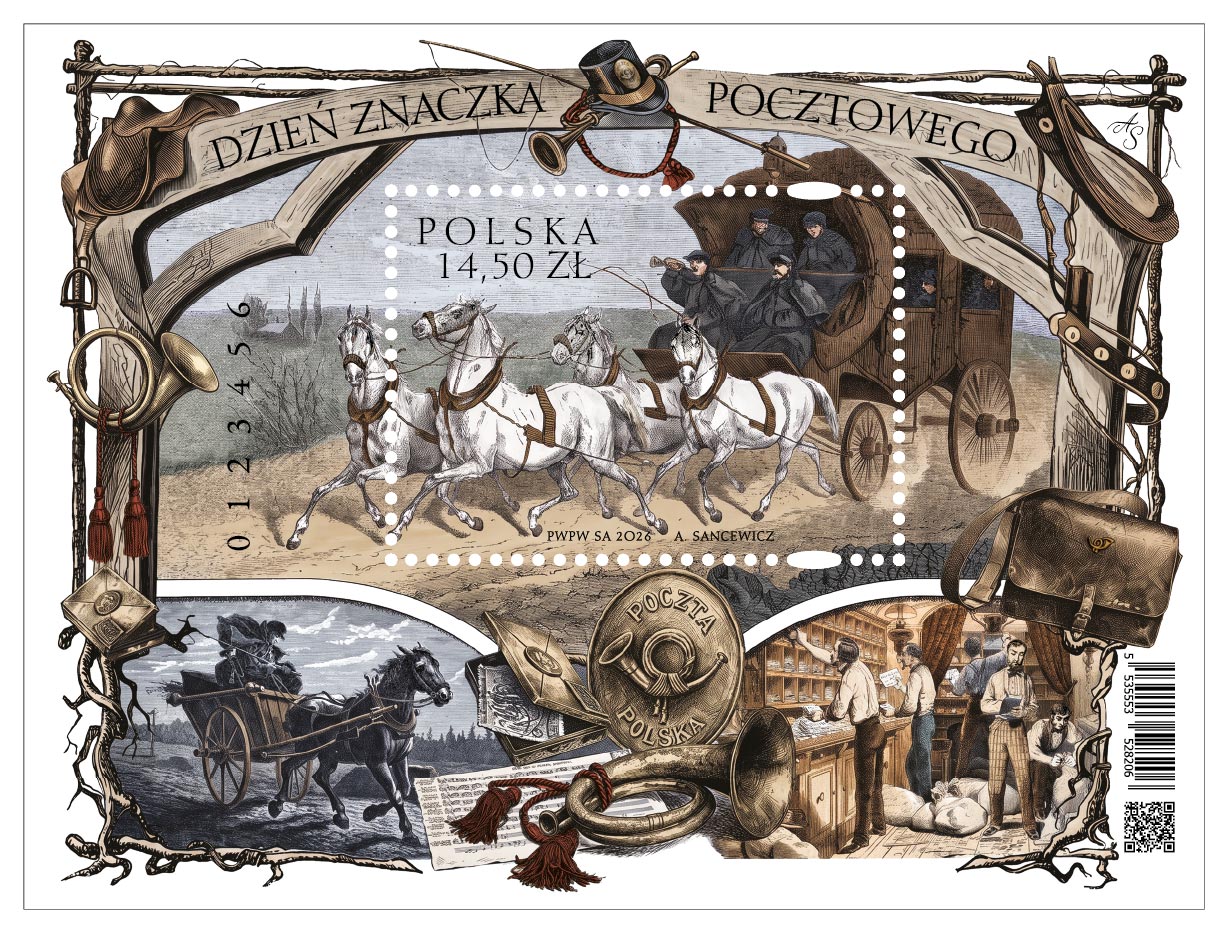
Poczta Polska has issued a miniature sheet that turns the history of carrying, sorting and collecting mail into the subject of a modern Polish stamp. The “Stamp Day” issue entered circulation on 9 October 2026, when Poland observes both World Post Day and its national Stamp Day. Rather than centring the composition on a single personality or anniversary emblem, designer Agnieszka Sancewicz assembled a visual account of postal work from historic engravings and objects preserved by the Museum of Post and Telecommunications in Wrocław. The result is a philatelic object about philately itself, but also about the people, vehicles and tools that allowed correspondence to move before automated sorting and digital tracking became routine.
The issue consists of one 14.50-złoty stamp within a 100 by 75 millimetre block. The stamp measures 43 by 31.25 millimetres and was printed by offset on fluorescent paper. Poczta Polska produced 68,000 blocks, including 4,000 imperforate examples. Those figures create two clearly distinguishable formats for specialists: the normal perforated block intended for general sale and postal use, and a much smaller imperforate component aimed at the collector market. Because the principal design is integrated with the surrounding sheet, retaining the complete block is important for understanding the full composition.
At the centre is a detail from the historic print “Postal courier on a paved road”. Around it, the block incorporates three further works: “Letter Post”, “Interior and Employees of a French Railway Post Office” and “Postillion”. Together they show different stages in the movement and handling of correspondence. The courier evokes road transport; the postillion recalls the horse-drawn postal system; and the railway-mail interior represents the period when letters were sorted while trains carried them between cities. This was an important change in postal logistics because travelling post offices reduced the time between collection and onward dispatch.
The surrounding objects make the design more than a montage of transport scenes. A postal horn, a letter carrier’s delivery bag and a gold badge once worn by a city postman represent the equipment and identity of postal employees. A silver stamp case made for the four-hundredth anniversary of the discovery of America introduces the collector’s perspective. These museum objects connect institutional history with the small, personal tools used in daily postal work and in the care of stamps. Their inclusion also gives thematic collectors several routes into the issue, including postal uniforms, badges, horns, transport, railways, museums and the material culture of communication.
The first-day cover continues the historical narrative with an engraving of postal workers receiving, sorting and processing letters and parcels. The special cancellation shifts the viewpoint from postal operations to collecting: it shows a philatelist holding a stamp with tweezers. That detail is especially apt for Stamp Day because it represents the careful handling that collectors use to protect gum, paper and perforations. A complete first-day combination therefore joins three related elements—the block as a history of transport, the envelope as a scene of processing and the cancellation as an image of collecting.
The release also points back to two landmarks in the development of adhesive postage. Britain’s Penny Black appeared in 1840 as the first adhesive postage stamp, while the first stamp issued for the Kingdom of Poland followed in 1860 and is now known to collectors as “Poland No. 1”.
Followers
Loading...